
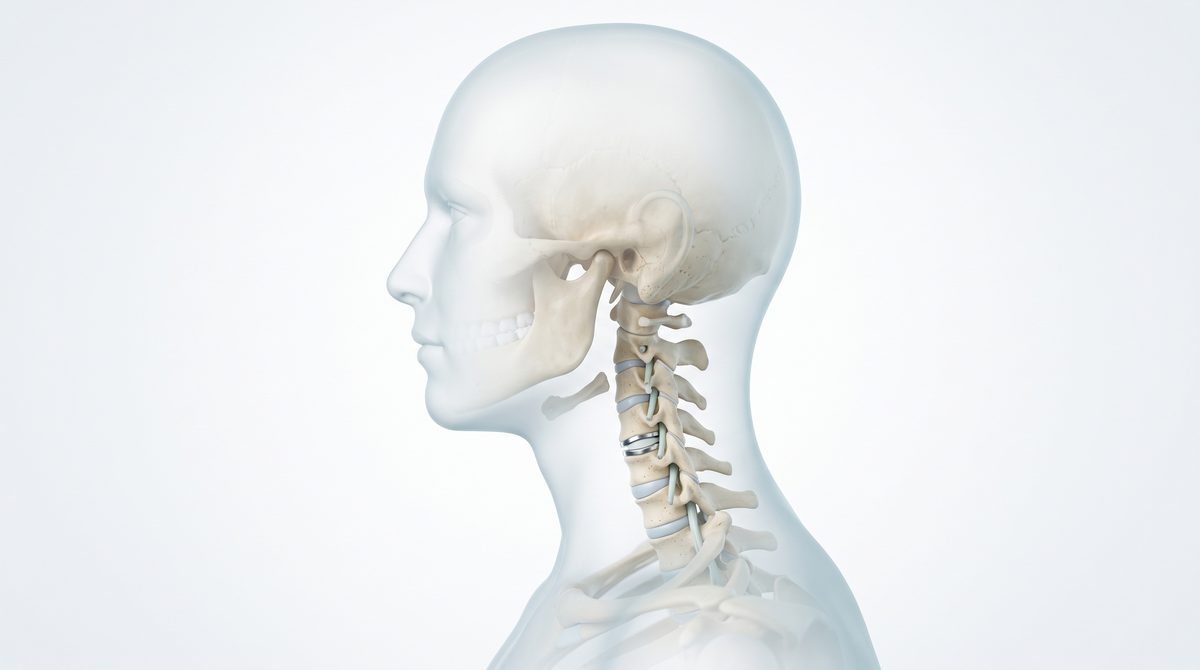
What cervical disc replacement is
Your neck has seven vertebrae, and between most of them is a disc. Each disc has a tough outer ring and a softer center. The discs absorb load and let the neck bend and turn. When a disc wears down or part of it pushes backward, it can press on a nerve root or on the spinal cord. That pressure can cause neck pain, pain that shoots into the shoulder blade or arm, numbness, tingling or weakness in the hand.
In a cervical disc replacement, also called cervical arthroplasty or total disc replacement, the surgeon removes the damaged disc and any bone spurs that are pressing on the nerves. The empty space is then filled with an artificial disc. The implant is made of metal, plastic or ceramic parts, depending on the design, and it is built to allow movement between the two vertebrae.
The goal is the same as any neck operation for a pinched nerve: give the nerve or spinal cord more room. The difference is what happens to the joint afterward.
Disc replacement or fusion?
The more traditional operation is an anterior cervical discectomy and fusion, often called ACDF. The first part is the same. The disc is removed through the front of the neck and the nerves are freed. In a fusion, a spacer and bone graft go into the disc space, usually held with a small plate and screws, so the two bones heal into one solid piece.
ACDF has decades of use behind it and remains the right choice for many people. A fusion stops motion at that level, and the levels above and below may take on more load over time. Disc replacement is designed to keep motion at the treated level instead. Researchers have compared the two operations for many years, and the long-term studies are part of the conversation at your visit. What matters most is which operation fits your anatomy, your imaging and your health.
For a side-by-side look, read cervical disc replacement vs. ACDF.
Who may be a candidate
Disc replacement is usually considered for adults with arm symptoms or spinal cord pressure from one or two discs in the lower neck. Common reasons include:
- A cervical disc herniation causing arm pain, numbness or weakness that has not improved with nonsurgical care
- Disc degeneration in the neck with bone spurs that narrow the space for a nerve root
- Early spinal cord pressure from a disc at one or two levels
It may not be a good fit if you have:
- Significant arthritis in the small facet joints at the back of the neck
- An unstable neck, or a neck that has lost its normal curve and bends forward
- Weak bones from osteoporosis
- A disc that has collapsed so far that the level barely moves
- Problems at more than two levels, some forms of ligament calcification, an active infection, or an allergy to the implant materials
Neck pain alone, without nerve or spinal cord pressure, is usually treated without surgery. X-rays that show how your neck moves, an MRI, and sometimes a CT scan help decide whether a replacement, a fusion or no surgery makes the most sense.
How the surgery works
Front approach
A short incision is made in a skin crease on the front of the neck. The windpipe, food pipe and main blood vessels are gently moved to the side.
Disc removal
Under magnification, the surgeon removes the worn disc and any bone spurs, and frees the nerve roots and spinal cord.
Sizing
The disc space is prepared and x-ray is used to choose the implant size and confirm its position in the middle of the spine.
Implant and close
The artificial disc is placed, its position is checked on x-ray, and the incision is closed, often with dissolving stitches.
The operation is done under general anesthesia. For one level it often takes one to two hours. Coming in from the front lets the surgeon reach the disc without cutting through the neck muscles at the back.
Recovery: what it tends to look like
These ranges describe common experiences. Your own recovery depends on the number of levels, your health and your work.
- Hospital stay. Dr. Higginbotham operates at Fresno Surgical Hospital. Many patients go home the same day or after one night.
- Swallowing and voice. A sore throat, a feeling of a lump when swallowing, or a hoarse voice is common for days to a few weeks. Soft foods help early on.
- Arm symptoms. Arm pain from a pinched nerve often eases early. Numbness and strength can take weeks to months, and may not fully return.
- Collar. Many patients do not need a hard collar after a disc replacement. Some are given a soft collar for comfort.
- Driving and work. Driving usually waits until you are off opioid pain medicine and can turn your head to check traffic. People with desk jobs often return in one to three weeks. Heavier work may take six weeks or more.
- Follow-up. X-rays at follow-up visits check the implant position and how the level is moving.
Risks
All neck surgery carries risk. Risks of cervical disc replacement include:
- Trouble swallowing or hoarseness, usually short-term and rarely lasting
- Infection, bleeding, or a blood collection in the neck that can affect breathing and needs urgent care
- Injury to the food pipe, windpipe, blood vessels, nerve roots or spinal cord, all of which are uncommon
- Bone forming around the implant over time, which can reduce motion at that level
- The implant shifting, wearing or needing to be removed or converted to a fusion
- New problems at a nearby level in later years
- Symptoms that do not improve as hoped
We will explain how these risks apply to you and what is done to lower them.
Dr. Higginbotham and disc replacement
Cervical disc replacement is one of Dr. Higginbotham's focus procedures. It was listed among his areas of expertise when he joined practice in Fresno after finishing his spine fellowship at UC Davis. In early 2026 he performed his first cervical total disc replacement with the Simplify Cervical Disc at Saint Agnes Medical Center. That patient had neck and shoulder pain with pain and numbness running down the arm, and the disc was chosen to help keep natural motion at the treated level.
He also performs anterior cervical fusion, so the recommendation you get is based on what fits your neck, not on a single technique.
Questions to ask at your visit
- Is my problem at one level or more than one?
- Does my imaging show facet arthritis or anything else that would make a fusion the safer choice?
- What implant would you use, and why?
- How will my swallowing and voice be watched after surgery?
- What activity limits will I have in the first six weeks?
- Can I have an MRI of my neck later with this implant in place?
If you already have a surgical plan from another doctor, read getting a second opinion on spine surgery.
Frequently asked questions
How long does an artificial disc in the neck last?
Artificial neck discs have been studied for many years, and follow-up studies continue. Wear, bone growth around the implant and changes at nearby levels are monitored with x-rays over time. We will talk about what the current research shows for the implant being considered for you.
Can I have disc replacement at two levels?
Some devices are approved for one or two neighboring levels in the lower neck. Whether two levels makes sense for you depends on your imaging, your facet joints and your bone quality.
Will I set off metal detectors?
Some implants contain metal and some are made mostly of plastic or ceramic parts. Your implant card will list the materials. Most people pass through security without problems.
Why is the surgery done from the front of the neck?
The disc sits in front of the spinal cord. The front approach gives a direct path to the disc and the bone spurs behind it, without cutting the muscles at the back of the neck.
Will I lose neck motion?
Disc replacement is designed to keep motion at the treated level. How much motion you keep differs between people and can change over time.
What if I am not a candidate for disc replacement?
An anterior cervical fusion or a smaller operation from the back of the neck may be options. Many people with a pinched nerve in the neck also improve without surgery.