
What navigated spine surgery is
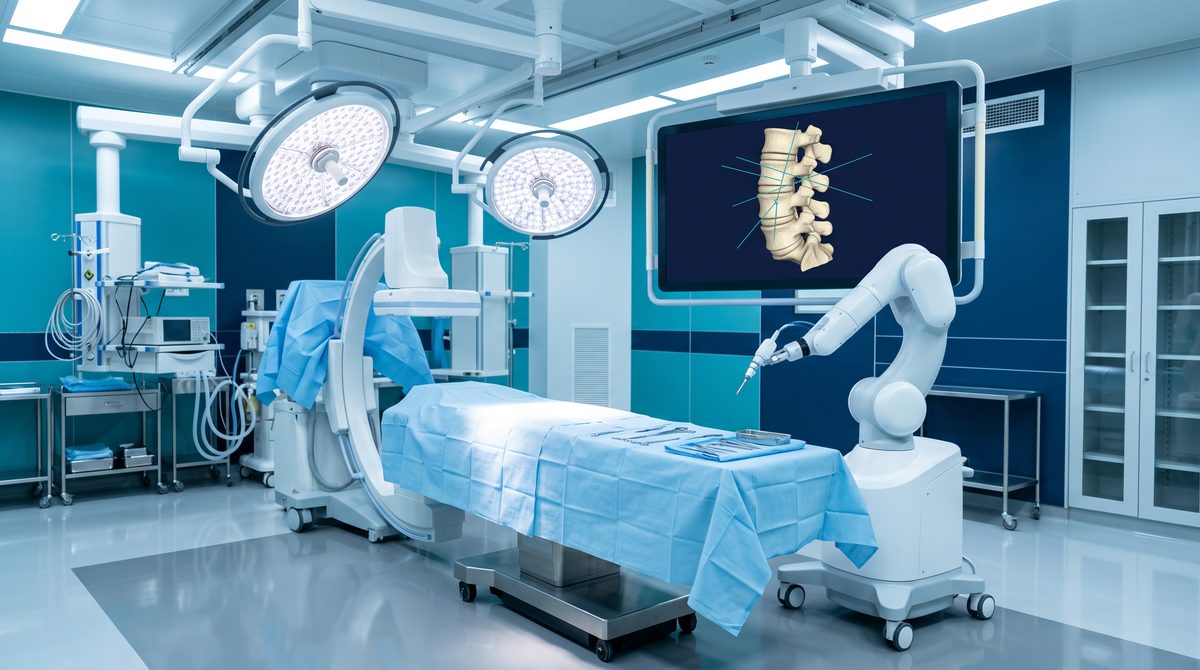
Spinal navigation is often compared to GPS. Instead of a map of roads, the surgeon works from a 3D map of your spine. Instead of a phone, the tracked tools are the drill, probe and screwdriver. A camera in the room follows small markers on those tools and on a reference frame attached to your spine. The computer then shows the tip of each instrument on the 3D image, from several angles at once.
Navigation is not a separate operation. It is a guidance tool used inside another operation, most often a spinal fusion. In a fusion, screws are placed into the pedicles, two small columns of bone on the back of each vertebra. The pedicles sit very close to the spinal nerves, the spinal cord and major blood vessels. Navigation helps the surgeon plan the angle and length of each screw and then follow that plan.
Robotic assistance
Some navigation systems add a robotic arm. The surgeon plans each screw path on the 3D image before placing it. The arm then moves into position and holds a guide on that planned path while the surgeon does the work. The surgeon stays in control the whole time. The robot does not operate on its own and does not make decisions.
Robotic guidance is one option within navigation. Whether it is used depends on the operation, the hospital and your anatomy. Many navigated operations are done without a robotic arm.
Who may benefit
Navigation is used when precise screw placement matters or when normal landmarks are hard to see. That often includes:
- Spinal fusion for a slipped vertebra (spondylolisthesis) or an unstable segment, sometimes needed with stenosis in the lower back
- Adult deformity correction, where many screws are placed along a curved or rotated spine
- Minimally invasive fusion, where screws are placed through small incisions and the surgeon cannot see the bone directly
- Revision surgery, where earlier surgery has changed the anatomy
- Spines with unusual anatomy, small pedicles or low bone density
Most people who need a fusion have tried nonsurgical care first. The reason for a fusion, not the navigation, is what decides whether surgery makes sense. Common reasons include instability, nerve pressure that cannot be relieved safely without stabilizing the spine, and spinal deformity in adults. Fusion for worn discs is considered only in selected cases.
How navigated surgery works
Reference frame
After you are asleep and positioned, a small frame with markers is attached to bone near the surgery. It lets the camera track your spine.
3D scan
An imaging device spins around you and builds a CT-style 3D picture of your spine in the operating room.
Plan the path
The surgeon plans the entry point, angle and length of each screw on the 3D image, checking it against the nerves and edges of the bone.
Guided placement
Tracked tools, and sometimes a robotic arm, guide each screw along its plan. Position is confirmed with imaging before closing.
If the reference frame is bumped, the map may no longer line up with your spine. Surgeons check accuracy against known landmarks during the case and can re-scan when needed. The rest of the operation, such as removing bone to free the nerves or placing a spacer in the disc space, follows the plan for your fusion.
Recovery after a navigated fusion
Because navigation is a tool inside the main operation, recovery depends on the fusion itself: the number of levels, the approach and your health. Common patterns include:
- Hospital stay. At Fresno Surgical Hospital, often one to three days for a one- or two-level fusion. Longer for larger operations.
- Getting up. Most patients stand and walk with help on the day of surgery or the next day.
- Early limits. Many surgeons ask patients to avoid heavy lifting, repeated bending and twisting for the first several weeks while the bone starts to heal.
- Healing of the fusion. Bone fusion is a slow process. It often takes six months to a year for the bones to grow together fully.
- Work. Desk work may resume in several weeks for some people. Physical work often takes three months or more.
- Things that slow bone healing. Nicotine in any form, poorly controlled diabetes, low vitamin D and weak bones can all slow a fusion. We check for these before surgery.
For a broader look at the months after surgery, read recovery after spine surgery.
Risks
Navigation is meant to support accuracy. It does not remove the risks of spine surgery. These include:
- Infection, bleeding and blood clots
- Nerve or spinal cord injury
- A screw that is out of position, which is still possible with navigation
- Screws loosening, or rods or screws breaking
- The bones not fusing (called a nonunion or pseudarthrosis)
- Extra wear at the level next to the fusion in later years
- Radiation from the 3D scan, and a longer setup time in the operating room
- Pain that does not improve, and the need for more surgery
Dr. Higginbotham and navigated surgery
Dr. Higginbotham trained in orthopaedic spine surgery with a fellowship at UC Davis. His expertise has included minimally invasive robotic surgery, and in 2026 he performed the first spine procedure using the Mako 4 robotic system at Saint Agnes Medical Center, according to the hospital. Saint Agnes was reported as the first in the Central Valley to use Mako 4 for spine surgery. The hospital describes the system as providing patient-specific surgical planning and robotic-assisted guidance that supports screw placement, paired with a 3D C-arm for imaging.
He has also co-authored a review of image-guided and virtual and augmented reality tools in spine surgery (Cureus, 2023) and a systematic review of a bone graft material used in lumbar fusion (Global Spine Journal, 2024).
Questions to ask at your visit
- Why do I need a fusion, and what would happen if I waited?
- How many levels would be fused, and from which direction?
- Will navigation or a robotic arm be used, and what does it add in my case?
- How much radiation will the 3D imaging involve?
- Is my bone density good enough for screws, and should it be tested first?
- How long until I can lift, drive and return to work?
Our guide to getting ready for surgery covers what to do in the weeks before.
Frequently asked questions
Does a robot perform the surgery?
No. The surgeon plans and performs the operation. A robotic arm, when used, holds a guide steady on the planned path. It does not move on its own or make decisions.
Is navigated surgery the same as minimally invasive surgery?
Not always. Navigation can be used in open surgery and in minimally invasive surgery. It is especially useful in minimally invasive cases, where the surgeon cannot see the bone directly.
How much radiation is involved?
The 3D scan in the operating room uses x-ray, similar to a CT scan. In many cases it can reduce the number of separate x-ray shots taken during screw placement. Your surgeon can explain the dose for your operation.
Does navigation make recovery faster?
Navigation is a guidance tool. Recovery depends mostly on the fusion, the number of levels and your health. It is not a reason by itself to expect a shorter recovery.
Can navigation be used if I have had spine surgery before?
Yes. Revision surgery is one of the situations where a 3D map can help, since earlier surgery changes the normal landmarks.
Is navigated surgery covered by insurance?
Coverage is based on the operation you need, such as a fusion, and on your plan's rules. Our office can check what your plan requires before surgery is scheduled.